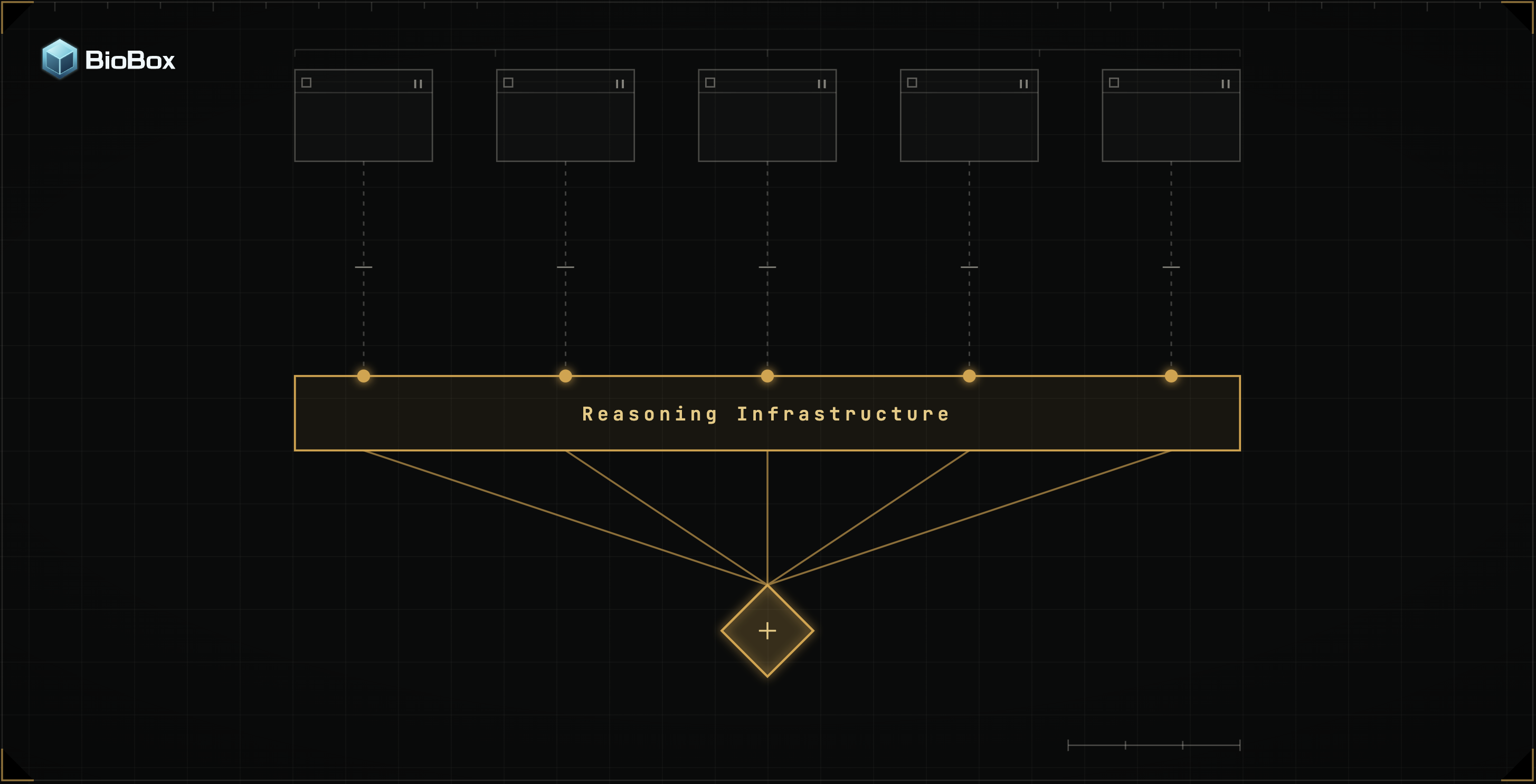
The backbone of a successful drug program is a series of decisions. The reasoning behind each decision is the most valuable asset a company has, and today it has no home. Organizations are carrying the most valuable resource they own entirely uninsured.
The biggest risk used to be institutional knowledge walking out the door when a scientist leaves. Now it's much worse. The race to put AI in the loop is quietly moving decades of judgment into models that companies don't own. Manage that wrong, and the edge becomes someone else's product.
Understanding how and why previous decisions were made is as challenging as making new ones. This challenge shows up in questions such as:
- Should we still pursue our lead target after a competitor has released phase 1 toxicity data?
- What additional indications is our asset suitable for that are in line with our commercial strategy?
- Why do we believe that biological pathway X is a key driver of indication Y?
This challenge is omnipresent because the reasoning behind those decisions was never captured in a way anyone can retrieve.
What is decision provenance?
These are the tradeoffs and heuristics that go unspoken as a result of decades of experience. The indication-specific nuances. The concessions that scientists arrived at during an in-person meeting that remain hidden in slide 44 of a SharePoint.
For key opinion leaders and industry veterans this knowledge becomes tacit, second nature. For the rest of the organization, that tacit institutional knowledge becomes elusive, and it slips out the door as soon as scientists leave.
Capturing this logic and making it accessible to cross-functional teams is the core substrate of decision provenance. But capturing it is not enough. This knowledge needs to be operationalized to drive future decisions and eliminate repeated mistakes.
Imagine sending a self-driving car to a specific location, and every time it returned, the left side was completely totalled. Instead of looking back at the data and route history, you repair the car and send it back down the same route, only for it to return totalled once again.
This is exactly what it's like to make high-stakes decisions without decision provenance.
The cost of relearning what you already knew
When it's time to revisit a previous decision, weeks are spent repeating analyses and doing detective work.
A target gets deprioritized. At the time, it's a sensible call. Two years later, a competitor publishes promising phase 1 data, and someone in portfolio review asks the obvious question. Why was this program killed?
The reasoning was never written down. It lived in a meeting and a deck that no longer exists. So a team spends the next quarter reconstructing an argument that took an afternoon to produce. They re-run the analyses, interview whoever is still around, and arrive back at a version of the same reasoning, now stale, having burned time and R&D resources.
This is not a one-off. Every revisited portfolio decision must be re-derived. New hires inherit conclusions without the reasoning behind them, so they either trust the call blindly or redo the work to believe it. The time cost is not the occasional fire drill. It is a tax on every decision the organization ever wants to look at twice.
IP and sovereignty in the AI race
Institutional knowledge isn't just expensive to lose. It's the asset that dictates who owns your expertise, and the AI race has raised those stakes sharply.
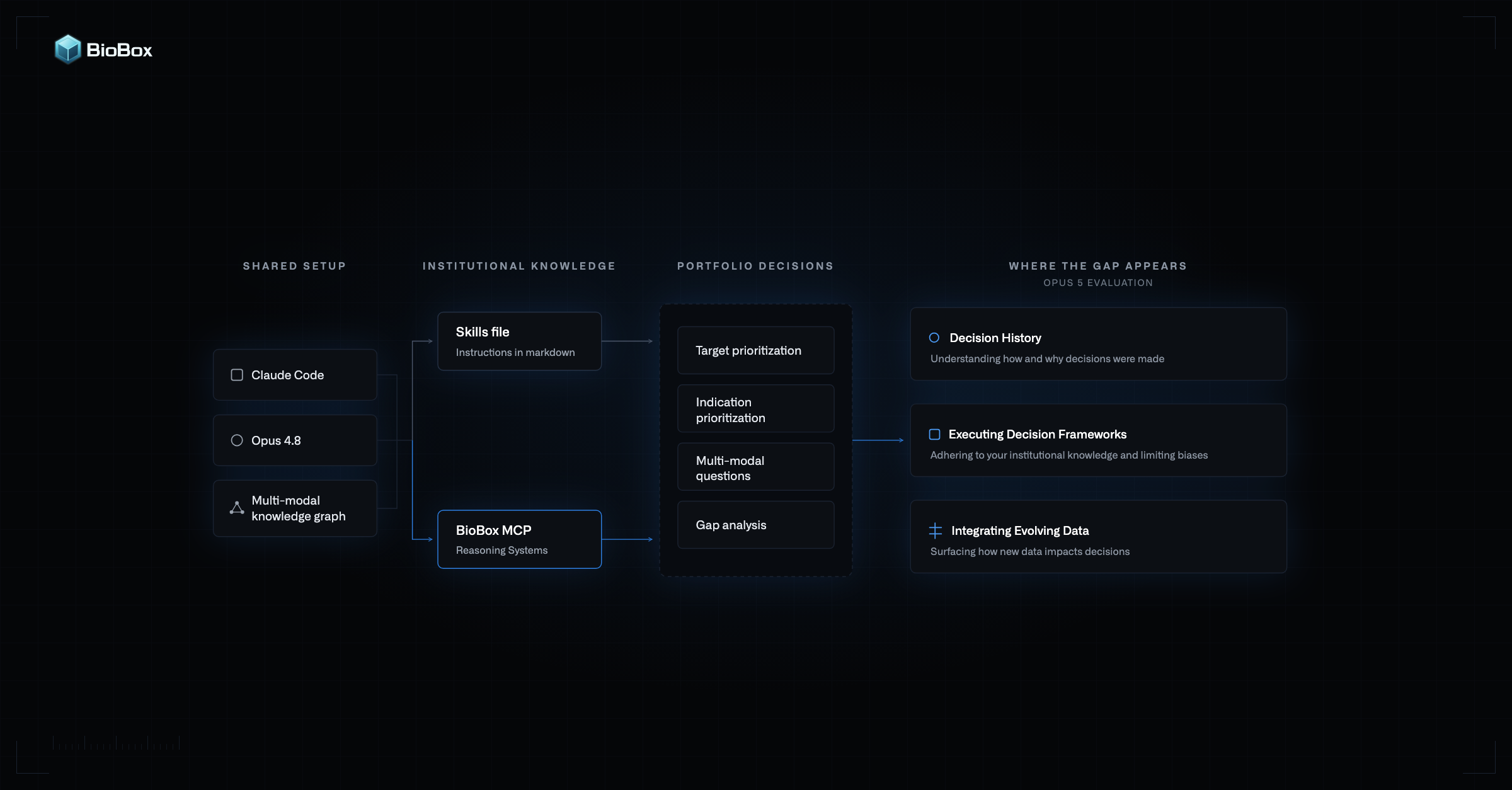
It's no secret that we are in a race toward the best domain-specific agents. In drug discovery, when the stakes are as high as life-saving medications, there is no room for error. Companies are trying to source the best AI co-scientists. However, they arrive without an organization's proprietary institutional knowledge, which makes them hard to trust with high-stakes decisions. Skills files and prompt engineering can only get you so far, especially when it comes to complex biological decision making.
Microsoft CEO Satya Nadella put the test plainly. A company should be able to switch out a "generalist" model without losing the "company veteran" expertise built into its learning system. He calls that the key test of your control and sovereignty in the era ahead.
If your institutional knowledge only exists in the context of one vendor's model, you have not captured your expertise. You have rented it. The moment a better model ships, or the pricing changes, or worse the model completely disappears (ahem, Fable), you are left with a choice. Stay on a model you are outgrowing, or switch and leave your company's institutional knowledge behind, baked into a system you are walking away from.
Infrastructure for decision provenance is what gets you out of this catch-22.
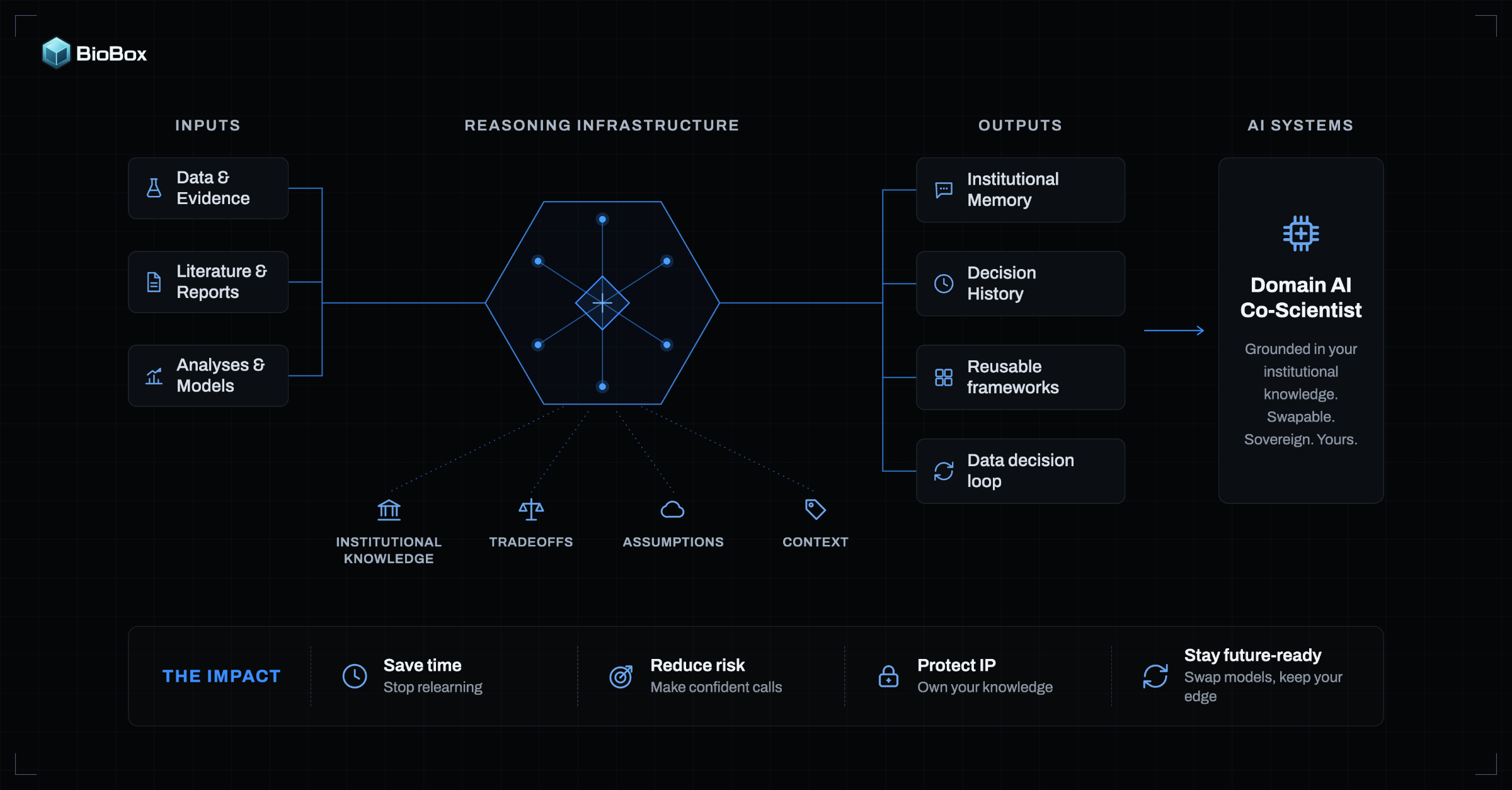
When the reasoning lives in infrastructure you own, captured as structured frameworks, the model becomes an interchangeable engine and the expertise stays yours. If a better engine or AI co-scientist arrives, you'd freely swap it in, and the institutional knowledge rides along untouched. The model is a commodity, whereas the knowledge is the moat. Decision provenance is what keeps the moat on your side of the wall.
Infrastructure for decision provenance
Three layers are required to maintain decision provenance.
- 01A multimodal data foundation. Integrated data that the decision provenance references. Scientists, human and AI, need an easy way to access all of their data in one connected ecosystem.
- 02Reasoning frameworks and decision modules. The logic and tradeoffs used to make historical decisions and drive future ones. Think of it as the git history for your most complex decisions, ready to be leveraged by your human scientists or AI co-scientists of choice.
- 03Decision-ready interfaces and integrations. An ecosystem for cross-functional decision making. This is where the reasoning meets the actual decision. A cross-functional team reviews a call and sees the exact reasoning that produced it, not a slide someone made about it. R&D teams can make portfolio decisions with confidence by leveraging decision modules and historical learnings. The data and the decision modules only create value when teams can act on them, and this is the surface where that happens.
At BioBox, we provide this infrastructure to AI-forward pharmaceutical organizations that are looking to own and operationalize institutional knowledge to drive decision making. The platform serves as the connective tissue for R&D teams.
Institutional knowledge is one of the most valuable assets in an organization. Decision provenance is what it looks like when you finally treat it like one.